I want to print the data of array by usingpointers so I try to save the address of array in the pointer. But the pointer doesn't print the data. I will print a second array as well later on so the...
In this article, we will learn all about one-dimensional (1D) arrays in C, and see how to use them in our C program. A one-dimensionalarray can be viewed as a linear sequence of elements. We can only increase or decrease its size in a single direction.
Conclusion Mastering %s and %c in printf() requires understanding C’s string model (null-terminated chararrays) and pointer basics. Remember: %c prints a single character (pass a char or ASCII int). %s prints a null-terminated string (pass a char* to the first character). Mixing pointers and values (e.g., %s with a char) causes crashes or ...
In this program, the elements are stored in the integer array data[]. Then, the elements of the array are accessed using the pointer notation. By the way, data[0] is equivalent to *data and &data[0] is equivalent to data data[1] is equivalent to *(data + 1) and &data[1] is equivalent to data + 1
Declare a charpointer p pointing to the beginning of the array. Usepointer arithmetic (p + N) and the dereference operator to print the third character (‘D’) of the array.
Somewhere in the implementation of printf, there's a loop that takes the pointer value that was passed in, dereferences it to obtain the character value to be printed, and then increments the pointer so it points to the next character of the string ('F').
One of the main applications of the array of pointers is to store multiple strings as an array of pointers to characters. Here, each pointer in the array is a characterpointer that points to the first character of the string.
In this tutorial, we will learn about the relation between arrays and pointers with the help of examples. A pointer can store the address of each cell of an array.
Except for the std::vector<bool> partial specialization, the elements are stored contiguously, which means that elements can be accessed not only through iterators, but also using offsets to regular pointers to elements. This means that a pointer to an element of a vector may be passed to any function that expects a pointer to an element of an array.
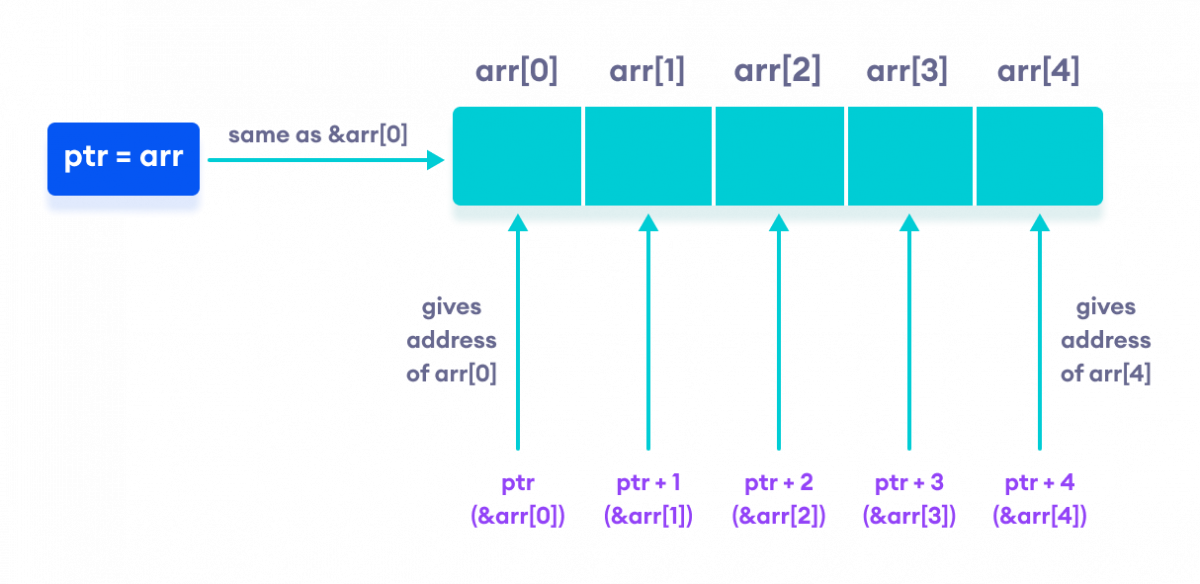 In this tutorial, we will learn about the relation between arrays and pointers with the help of examples. A pointer can store the address of each cell of an array.